

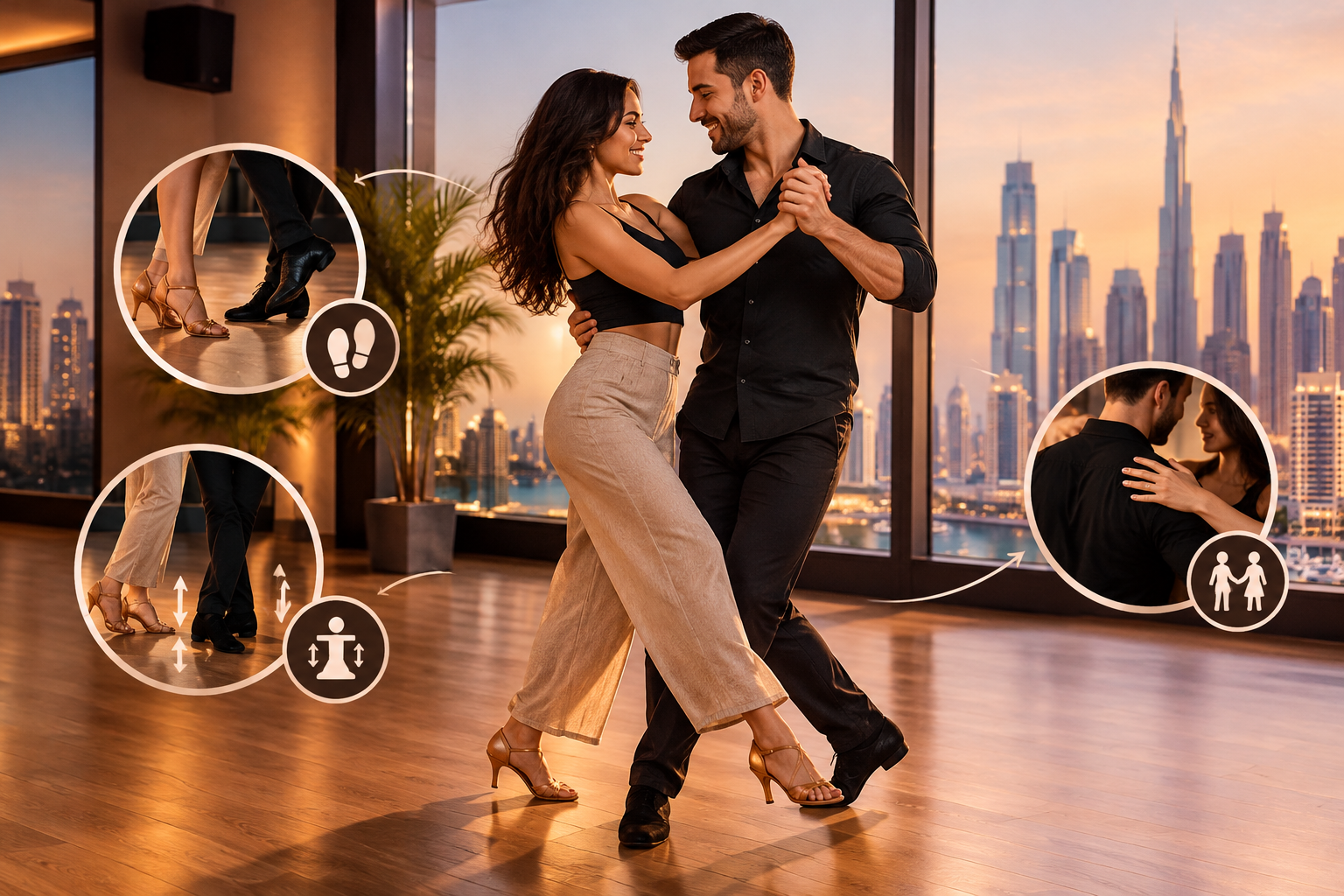
What are the basics of partner dancing?
For a complete beginner, partner dancing should start with basic footwork, weight transfer, rhythm, musicality and clear lead-follow communication—not complicated choreography.
The reason is simple: if you understand where your weight is, when you should move and how your body communicates with your partner, turns and combinations become much easier.
At VR Dance World, the teaching philosophy is straightforward: don’t just learn what step to do; understand why the movement works.
And yes—if you can walk, you can dance.
Walking already involves weight transfer. Partner dancing simply teaches you to control that transfer in different directions, rhythms and patterns.
What Are the Basics of Partner Dancing?
A good beginner foundation usually develops in this order:
- Basic footwork
- Weight transfer and balance
- Rhythm and musicality
- Body movement
- Lead and follow
- Basic turns and patterns
- Styling and more complex combinations
This does not mean every dance style follows exactly the same syllabus. Salsa, Bachata, Jive, Cha-Cha and Ballroom each have different technical requirements.
But the underlying principle remains consistent:
Build control before adding complexity.
This is particularly important in social partner dancing because your movement affects another person.
Why Should Footwork Come First?
Footwork gives beginners a physical map of the dance.
Before worrying about looking stylish, you need to know:
- Where is your next step?
- Which foot takes the weight?
- When does the weight change?
- Where is your body facing?
- How does the movement connect to the music?
For example, in Salsa, beginners need to become comfortable with the basic rhythm and stepping pattern before adding complicated turns.
The goal isn’t to memorise dozens of steps.
The goal is to make a small number of fundamental movements clear, balanced and repeatable.
That is why structured beginner training can be more useful than randomly collecting choreography from different videos.
What Is Weight Transfer in Dancing?
Weight transfer is the controlled movement of your body weight from one foot to another.
You already do it when you walk.
When you take a step forward, your weight moves from one leg to another. Dance takes that everyday movement and makes it more precise, rhythmic and intentional.
This matters because weight transfer affects:
- balance
- timing
- turns
- footwork
- body movement
- partner connection
- lead and follow
If your weight is unclear, your partner may not know what movement you are intending.
If your weight transfer is controlled, the movement becomes easier to communicate.
A simple beginner exercise
Stand comfortably and slowly shift your weight:
Left → right → left → right
Then try:
Forward → centre → backward → centre
Now repeat the movement to music without rushing.
The objective isn’t to look impressive.
It is to become aware of where your weight actually is.
That awareness is one of the building blocks of partner dancing.
Why Is Musicality Important for Beginners?
One of the most common beginner challenges is not the inability to move—it is not knowing when to move.
Musicality means understanding how the music relates to your movement.
At VR Dance World, students are introduced to this from the beginning rather than being asked to memorise steps first. The teaching notes specifically emphasise connecting foot placement, counts, body movement and partner communication to the music.
For example, Salsa commonly uses:
1, 2, 3 – pause – 5, 6, 7 – pause
Those pauses are not “empty.” They can become part of the musical interpretation.
Bachata has a different rhythmic character, with movement across the eight-count structure and taps that create opportunities for expression.
The important beginner lesson is:
Don’t simply count the music. Learn to hear what your body should do with it.
When Should Beginners Learn Lead and Follow?
From the beginning—but progressively.
You don’t need to master complicated partner patterns before learning lead and follow.
In fact, introducing the concept early can prevent one of the biggest beginner mistakes: trying to communicate everything through the hands.
At VR Dance World, the approach is to teach partner communication through body movement, timing, weight transfer and controlled connection, with the hands acting as part of the communication system rather than independently moving around.
What does a good lead feel like?
A good lead should feel:
- clear
- controlled
- comfortable
- predictable enough to understand
- connected to the movement
A good follow should not have to guess what is happening.
The objective is not to force the movement.
It is to communicate it clearly.
That is why learning lead and follow correctly is more valuable than simply learning a large number of patterns.
Why Fancy Moves Shouldn’t Be Your First Goal
Imagine a beginner who knows ten impressive turns but cannot maintain balance, hear the beat or communicate with a partner.
Now imagine another beginner who knows only three basic movements—but performs them on time, transfers weight correctly and communicates clearly.
Who looks more comfortable on the dance floor?
Usually, it is the second dancer.
This is one of the central ideas behind VR Dance World’s teaching approach: fundamentals first, styling later.
Once footwork, timing, balance and connection become natural, fancy movements become easier to learn—and they are much less likely to look disconnected from the music.
Should Beginners Learn Salsa, Bachata or Another Partner Dance First?
There is no single correct answer.
Many beginners find Sansual Bachata Classes relatively approachable because of its smooth rhythm and accessible basic movement.
Salsa classes Dubai can feel more demanding initially because of its quicker footwork, turns and timing.
But your best starting style depends on your goals.
Choose Salsa if you enjoy:
- energetic music
- faster footwork
- turns
- social dancing
- dynamic partner movement
Choose Bachata if you prefer:
- smoother movement
- melodic music
- close connection
- rhythmic body movement
- a more relaxed starting point
If your longer-term goal is Latin Ballroom, competitive training or developing broad dance technique, a structured foundation can also introduce you to styles such as Cha-Cha, Rumba or Jive.
VR Dance World’s existing programs emphasise musicality, weight transfer, footwork and partner connection across these styles rather than treating dance as a collection of unrelated routines.
Can You Learn Partner Dancing Without Previous Experience?
Absolutely.
You don’t need to arrive knowing how to dance.
You also don’t necessarily need a partner.
VR Dance World’s FAQ confirms that students can learn individually, with private lessons available for individuals, couples and small groups.
For many beginners, the biggest barrier isn’t physical ability.
It is confidence.
They think:
“Everyone else will know what they’re doing.”
But every experienced dancer was once a beginner.
A structured class breaks the process into manageable pieces so you can focus on one skill at a time.
Why Private Dance Classes Can Help Beginners Learn Partner Dancing
Private instruction is particularly useful when a beginner wants individual correction rather than a one-size-fits-all pace.
With a private lesson, an instructor can focus specifically on:
- your foot placement
- weight transfer
- timing
- balance
- posture
- lead-follow communication
- turns
- musicality
- individual learning speed
This can be particularly helpful if you are nervous about joining a group, have limited time, are learning with a partner, or have a specific goal.
VR Dance World’s private program focuses on structured learning, musicality, clean technique, lead-follow communication, body movement and understanding rather than simply rushing through combinations.
What Does a Good Beginner Progression Look Like?
A sensible progression could look like:
Stage 1 — Awareness
Understand rhythm, posture and basic movement.
Stage 2 — Control
Develop footwork, balance and weight transfer.
Stage 3 — Musicality
Connect movement to timing and musical accents.
Stage 4 — Connection
Begin understanding lead and follow.
Stage 5 — Patterns
Learn basic turns and combinations.
Stage 6 — Styling
Add body movement, arms and individual expression.
Stage 7 — Social confidence
Apply the skills comfortably with different music and partners.
This is why knowing “how many steps” you have learned is not always a useful measure of progress.
A better question is:
Can I execute the basics comfortably, musically and with clear partner communication?
Instructor Insight — The Beginner Mistake We See Most Often
A common beginner’s instinct is to move the hands, hips or body because they believe those movements will make them “look like a dancer.”
But good styling shouldn’t be pasted onto movement.
It should develop from the movement.
If the weight transfer isn’t clear, exaggerated styling can make the movement harder to control.
If the body movement is correct, the styling can eventually become much more natural.
That is why VR Dance World introduces musicality, footwork, weight transfer and lead-follow concepts from the beginner stage, before progressing into more elaborate patterns.
The philosophy is simple:
Understand the movement first. Make it beautiful second.
Learning Partner Dancing in Greens, JLT or Dubai Marina
For people searching for dance classes near The Greens Dubai, JLT or Marina, convenience can make a real difference to consistency.
VR Dance World is located in The Greens and Downtown, which is convenient for students across Dubai, including JLT and Dubai Marina.
For residents of The Greens
If you’re searching for private dance classes near The Greens Dubai, the Greens location can be particularly convenient for beginners who want personalised coaching.
Explore Dance Classes in The Greens Dubai
For JLT residents
If you live or work around Jumeirah Lake Towers, private dance classes in JLT can be a practical option when you want individual attention and flexible progression.
VR Dance World’s private program states that flexible sessions are available for professionals around JLT, Marina, Greens and Business Bay.
For Dubai Marina residents
Those searching for salsa classes near Dubai Marina or personalised partner-dance training can consider private Salsa and Bachata sessions, with VR Dance World also serving Marina, Greens and JLT.
Explore Private Salsa & Bachata Classes near Dubai Marina
The key point is not simply being close to a dance studio.
It is finding a learning environment where the teaching method matches your goal.
How VR Dance World Approaches Beginner Partner Dancing
VR Dance World is built around the idea that beginners should understand why movement works, not simply reproduce a sequence.
The coaching philosophy prioritises:
- footwork
- weight transfer
- musicality
- timing
- balance
- body mechanics
- lead and follow
- partner connection
- styling
- progressive learning
Our leading instructors Shan & Raaj, are among the few coaches in the UAE certified by a WDSF affiliate to teach competitive Latin. Having trained with world champions and coached global talent, they bring a blend of elite technique and soulful artistry to Dubai’s diverse cultural society.
This expertise matters because beginner teaching isn’t about showing off advanced knowledge.
It is about making difficult concepts understandable.
The Bottom Line — Learn the Foundation Before the Fancy Moves
If you’re wondering what beginners should learn first in partner dancing, start here:
Footwork → Weight Transfer → Rhythm → Musicality → Body Movement → Lead & Follow → Basic Turns → Styling
You don’t need to master everything at once.
You don’t need previous dance experience.
And you don’t need to look like an advanced dancer on your first day.
Start with one step.
Understand where your weight goes.
Hear the music.
Communicate clearly.
Then build from there.
That’s how partner dancing becomes less intimidating—and much more enjoyable.
Frequently Asked Questions
What are the basics of partner dancing?
The fundamentals include footwork, weight transfer, balance, rhythm, musicality, body movement and lead-follow communication. These skills create the foundation for turns, combinations and styling.
What should beginners learn first in partner dancing?
Beginners should generally start with basic footwork, weight transfer and rhythm before progressing to complicated combinations. Lead and follow can then be introduced progressively alongside basic partner movements.
What is weight transfer in dancing?
Weight transfer is the controlled movement of your body weight from one foot to another. It is essential for balance, turns, timing and clear partner communication.
Can I learn partner dancing without a partner?
Yes. You can begin with individual technique and private instruction. VR Dance World offers private lessons for individuals as well as couples.
Are private dance classes good for complete beginners?
They can be particularly useful for beginners who want individual correction, personalised pacing or a focused learning plan. Private instruction can also suit people with limited schedules or specific goals.
Which is easier for beginners, Salsa or Bachata?
Many beginners find Bachata approachable because of its smooth rhythm and basic movement. Salsa can initially feel faster and more technically demanding. However, the best choice depends on your musical preferences and goals.
Where can I learn partner dancing near The Greens, JLT or Dubai Marina?
VR Dance World, a ballroom dance studio in Dubai offers private training serving communities including JLT and Dubai Marina.
Ready to Learn Partner Dancing the Right Way?
If you’ve been searching for private dance classes near me, private salsa lessons in Dubai, private Bachata classes near me, or simply a beginner-friendly way to understand partner dancing, start with the fundamentals.
You don’t need to know all the steps.
You just need to take the first one.
Book a private session with VR Dance World and learn how footwork, weight transfer, musicality and lead-follow connection come together to make partner dancing easier to understand.
